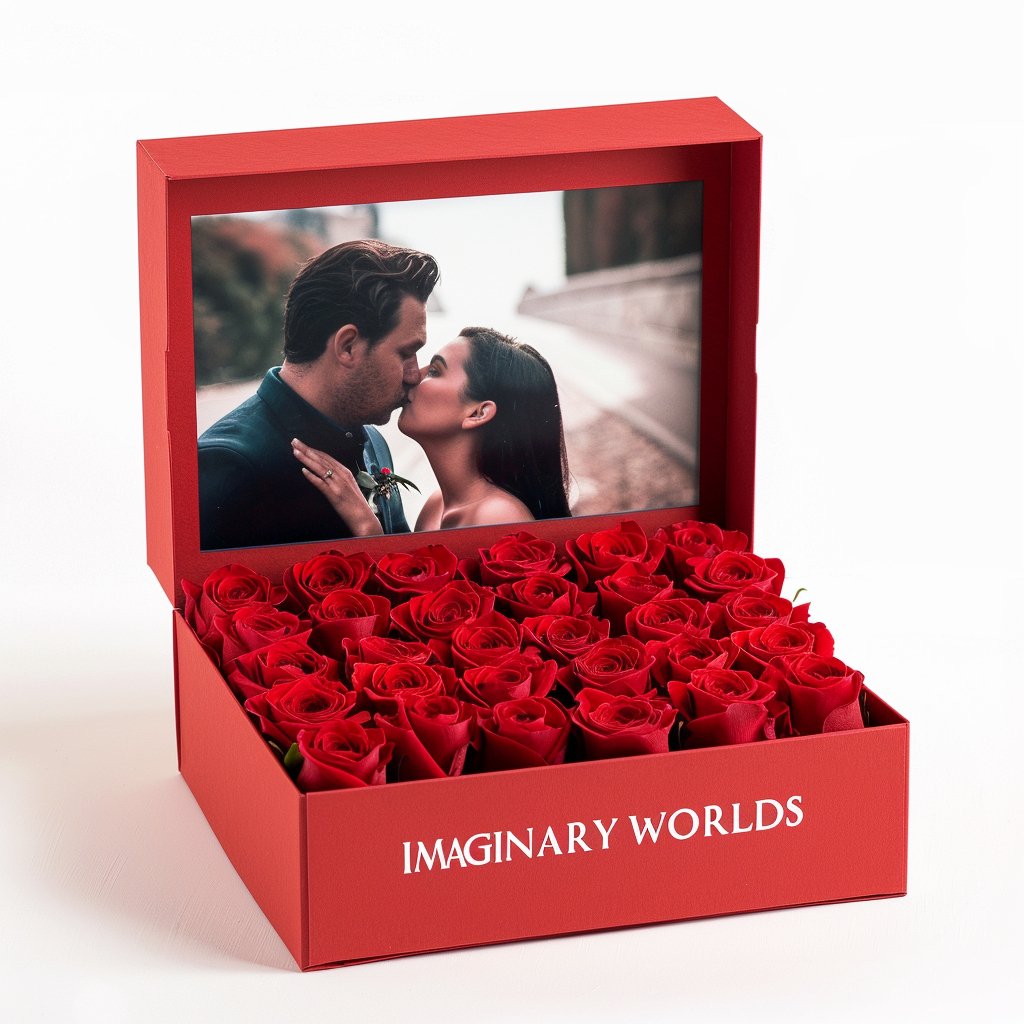
Preservation slows a flower's material change; environment and care determine how gracefully it continues.
By Imaginary Worlds Editorial
Preserved Roses · The IW Journal
Preserved roses last because the ordinary water-dependent life of a cut flower has been interrupted. Producers remove or exchange moisture within the tissues and introduce stabilizing compounds so petals retain more flexibility and form than a conventionally dried flower. With less free water and no need to remain biologically active in a vase, the rose changes much more slowly.
Preservation is not immortality. A well-made rose may remain presentable for a year or longer, but no responsible lifespan applies to every flower, treatment, climate, construction, and standard of appearance.
What a lifespan claim really means
A preserved rose does not normally fail on one exact day. Color may gradually fade, petals may collect dust, edges can become brittle, and the treatment may respond to humidity. One owner may accept subtle change while another expects the original appearance.
Rose-specific patents demonstrate that long retention is technically possible under defined formulations and conditions. They do not prove that every product uses the same process or deserves the same guarantee. Product-specific claims should come from verified testing and clearly stated display conditions.
The main factors affecting preserved roses
Humidity
High humidity can soften preserved botanical material, encourage surface changes, or cause treatment compounds to migrate. Very dry air can contribute to brittleness.
Light
Direct sunlight and ultraviolet exposure can accelerate fading and material degradation, especially in dyed petals.
Heat
Radiators, hot windows, appliances, and concentrated heat can dry or distort petals and affect adhesives or enclosures.
Handling
Repeated touching compresses, oils, tears, or loosens delicate petals. Preserved does not mean durable like plastic.
Construction
Cases, bases, adhesives, electrical parts, fabrics, and companion materials introduce their own aging and care requirements.
Humidity: the quiet risk
Preserved plant material is sensitive to moisture even though it should never be watered. Mississippi State University Extension notes that glycerin-preserved foliage can weep solution under humid conditions. Flowers and commercial treatments differ, but the underlying warning is useful: a damp bathroom, conservatory, or climate with uncontrolled humidity is not a neutral display environment.
Keep the complete object indoors and dry. If condensation appears inside a case or the petals feel unusually soft, move it away from the moisture source rather than applying heat directly.
Light and heat
A bright interior can display preserved roses beautifully without placing them in direct sun. Choose indirect light and avoid a windowsill where ultraviolet exposure and daily temperature swings are strongest. Dyed and naturally colored botanical material can both fade.
Keep the object away from radiators, fireplaces, heating vents, hot appliances, and lamps that are not part of its verified construction. For an illuminated floral object, follow its own operating and care guidance; this article does not substitute for electrical specifications.
Personal memory preserved with roses
Handling, dust, and enclosure
Touch preserved roses only when necessary and by the structural base rather than the petals. Do not mist, wash, or apply household cleaner or perfume. For exposed arrangements, use very gentle dry air or a soft brush to lift dust without crushing the bloom.
An enclosure reduces accidental contact and slows dust accumulation. It cannot make the rose permanent, and a poorly ventilated or damp enclosure can create its own problem. The best protection is stable placement plus minimal intervention.
A realistic care routine
Choose a dry indoor location away from direct sun and heat. Leave the object in its intended orientation. Inspect it occasionally for dust, condensation, loose components, or changes in the surrounding materials. Clean only as the maker recommends.
Do not rotate several unverified home remedies through the object. Water, hairspray, oils, fragrance, alcohol, and cleaning solutions can stain or disturb treated petals. If the piece includes lighting or a sealed case, contact the maker before attempting repair.
Preservation changes the speed of aging; care changes the conditions in which that aging occurs.
What remains unknown
IW does not currently publish controlled longitudinal photography showing the same rose under defined humidity, light, and heat conditions. It also does not publish verified longevity ranges for every construction. Those are meaningful evidence gaps, not invitations to repeat a generic ‘lasts forever’ claim.
Future testing should document treatment source, enclosure, climate, color change, petal condition, and the aging of adhesives or electrical components. Until then, the honest promise is comparative: preserved roses are designed to remain presentable far longer than fresh cut roses when kept in suitable indoor conditions.