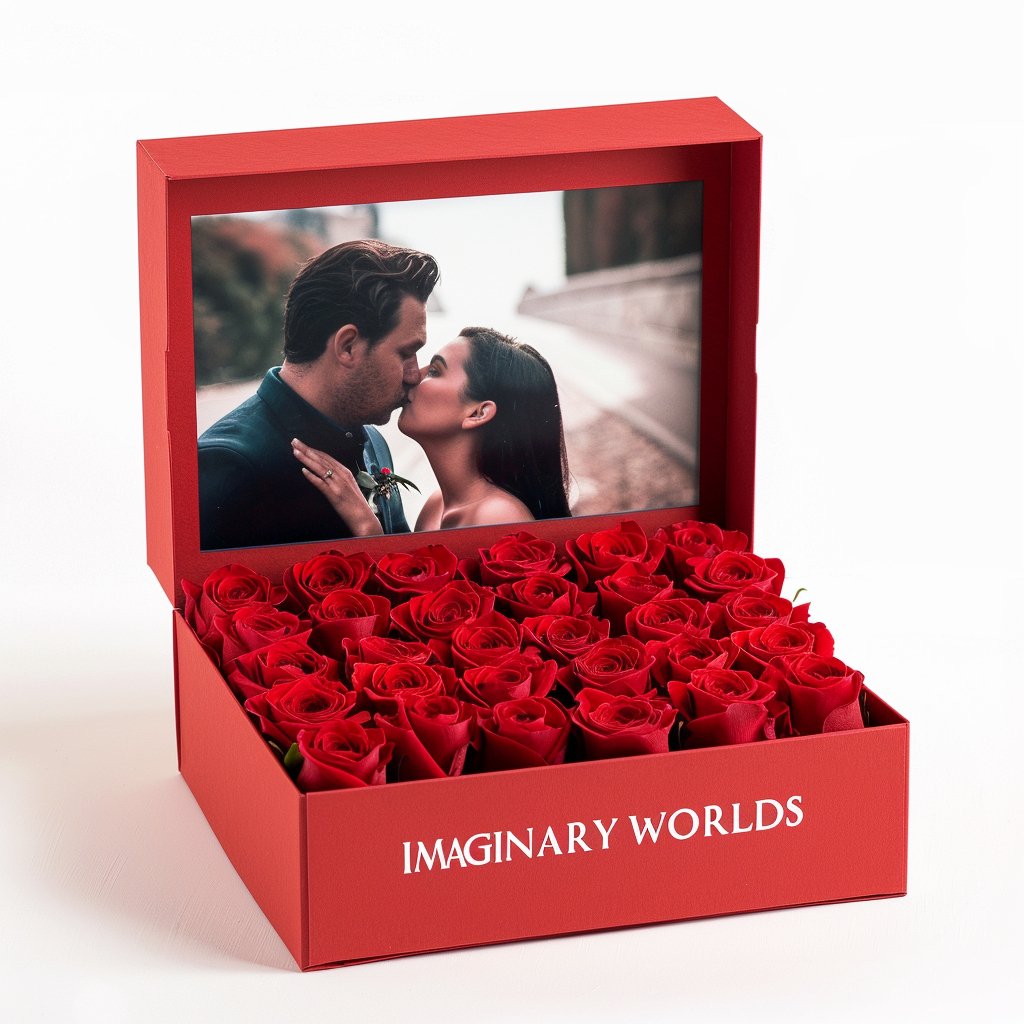
Two ways of experiencing a rose—one immediate and changing, the other composed to remain.
By Imaginary Worlds Editorial
Preserved Roses · The IW Journal
The essential difference is simple: a fresh rose is a living cut flower continuing through a brief natural cycle, while a preserved rose is real botanical material whose moisture has been removed or exchanged so that its form changes much more slowly. Fresh roses offer movement, scent, and the pleasure of a bloom opening in real time. Preserved roses offer duration, low-water care, and the possibility of being built into a lasting designed object.
Neither is universally better. The right choice depends on whether the moment calls for living freshness or a form intended to remain.
Preserved roses and fresh roses at a glance
Lifespan
Fresh cut roses are normally experienced over days, with vase life affected by cultivar and care. A well-made preserved rose may remain presentable for a year or longer, but results vary by treatment, climate, handling, and construction.
Care
Fresh roses need clean water, recut stems, floral food, sanitation, and a cool position. Preserved roses need no water; they should be kept dry, out of direct sun and heat, and handled sparingly.
Appearance
Fresh petals open, soften, curl, and eventually fall. Preserved petals retain a more stable pose, although texture, translucency, and color may differ from a newly cut bloom.
Scent
Fresh roses can carry a natural fragrance, though intensity varies by cultivar. Preservation usually diminishes or changes that scent; added fragrance should not be confused with the flower's original aroma.
Design potential
Fresh stems excel in loose bouquets and seasonal arrangements. Preserved roses can be composed into boxes, illuminated objects, and sculptural forms that are not designed around a vase of water.
Longevity is a tradeoff, not a verdict
A fresh rose makes time visible. Its bud loosens, petals change position, and fragrance may become more apparent before the flower fades. That transience is part of its emotional force: a fresh bouquet can make a dinner, ceremony, or ordinary room feel newly alive precisely because it will not remain unchanged.
Preservation exchanges that unfolding life for material continuity. Documented methods partially dehydrate a flower and introduce stabilizing compounds; the result does not need vase water and ages more slowly. Claims such as ‘lasts forever’ are not literal. Humidity, ultraviolet light, dust, contact, and differences in treatment all affect the useful display life.
Appearance, touch, and fragrance
Fresh roses have the greatest sense of immediacy. Their petals can feel cool and hydrated, their stems and leaves remain part of the composition, and their appearance changes from hour to hour. Their scent is not guaranteed—many commercial varieties have been selected for other qualities—but when fragrance is present it belongs to the living bloom.
Preserved roses are selected for a steadier silhouette. Processing can alter softness, weight, color, and scent; coloring may also create shades unavailable or inconsistent in fresh roses. Small botanical variations remain. A preserved rose should not be judged as an imitation fresh flower, but as transformed natural material with a different visual purpose.
Personal memory preserved with roses
Care and maintenance
Fresh roses reward active care. Illinois Extension recommends a clean container, fresh water and floral preservative, foliage removed below the waterline, periodic water changes, recut stems, cool temperatures, and distance from full sun and heat. Even careful maintenance extends rather than eliminates the natural cycle.
Preserved roses ask for restraint instead: do not water or mist them. Keep them indoors and dry, away from direct sunlight, strong heat, and repeated touching. Dust exposed designs gently with dry air or a very soft brush. Enclosed objects may reduce contact and dust, but their electrical, adhesive, or companion materials can have additional care needs.
When fresh roses make more sense
Choose fresh roses when seasonality, natural scent, movement, or a living tablescape matters. They suit weddings, dinners, performances, and gestures whose beauty belongs to a particular day. Fresh stems also offer flexibility: they can be rearranged, divided among vases, or combined with local foliage and flowers.
They may also be the more appropriate choice when the recipient enjoys the ritual of tending flowers and does not want another permanent object.
When preserved roses make more sense
Choose preserved roses when duration carries meaning: a photograph paired with a flower, a commemorative object, a design for a low-maintenance interior, or an arrangement whose geometry should remain composed. Their stability supports forms that fresh stems cannot sustain for long, including rose boxes and illuminated floral objects.
Cost should be considered in context. A preserved design can cost more at the outset because preservation, selection, structure, and casing add work and materials. That does not automatically make it better value, and it should not be defended with unverified environmental claims. Compare the actual object, expected display life, shipping, packaging, and whether the recipient wants a keepsake at all.
Fresh roses honor the present. Preserved roses give a memory a longer physical form.
A useful decision
For atmosphere now, choose the sensory change of fresh flowers. For an object intended to hold its form, choose preserved. For some occasions, the most expressive answer may be both: fresh flowers filling the event, with one preserved floral object remaining afterward.
The meaningful distinction is not natural versus artificial—both begin with real roses—but living cut material versus transformed botanical material. Once that difference is clear, the choice becomes less about which rose wins and more about what the gesture needs to do.