Real roses transformed for long-term display: what preserved roses are, how they differ from fresh and dried flowers, how they are made, and how to care for them.
Preserved roses are real roses treated so that their recognizable form, color, and softness can remain far beyond the ordinary vase life of a fresh cut flower. Their natural moisture is removed or exchanged and the tissue is stabilized, often with glycerol or related compounds. The finished rose is no longer living: it does not need water, continue opening normally, or retain the full scent cycle of a fresh bloom.
This guide is the starting point for understanding the material. It answers the central questions and connects to detailed Journal studies where process, comparison, longevity, and design deserve fuller treatment.
Fresh, dried, and preserved roses
Fresh rose
A living cut flower that takes up vase water and continues to open and age. It offers immediacy, movement, and possible natural fragrance over a relatively short display life.
Dried rose
A rose from which water has been removed by air, desiccant, heat, or freeze-drying. It can retain beautiful form but is usually lighter, crisper, and more brittle.
Preserved rose
A real rose whose moisture and tissues have been chemically stabilized. The goal is a more supple, dimensional flower suitable for long-term indoor display.
How are preserved roses made?
There is no single universal recipe. Documented commercial methods begin with fresh, sound flowers, then partially dehydrate or decolorize them before introducing a stabilizing solution. Some treatments move through a shortened stem; others use immersion, staged solvents, or impregnation. Dye may be introduced because treatment can alter the original shade.
After treatment, the rose is conditioned, inspected, shaped, and selected for design use. Preservation and object-making are separate stages: the first changes the botanical material; the second composes that material into a box, lamp, arrangement, or sculpture. The detailed process guide explains what is documented and where proprietary variation begins.
How long do preserved roses last?
A well-made preserved rose can remain presentable for a year or longer, substantially outlasting a fresh cut rose. Exact lifespan is not universal. Treatment method, rose variety, humidity, ultraviolet light, temperature, dust, handling, enclosure, and the viewer's standard of appearance all matter.
Terms such as forever rose describe a category and emotional idea, not literal permanence. Responsible guidance should avoid a guaranteed number unless it is supported by product-specific testing and clearly stated conditions.
How to care for preserved roses
Do not water or mist preserved roses. Keep them indoors and dry, away from direct sunlight, strong heat, damp rooms, and repeated touching. For exposed designs, remove dust with gentle dry air or a very soft brush. Do not apply household cleaners to petals.
A case can reduce dust and accidental contact, but it does not neutralize humidity or heat. Follow the care instructions for the complete object, especially when it includes lighting, adhesives, photographs, fabric, or other materials.
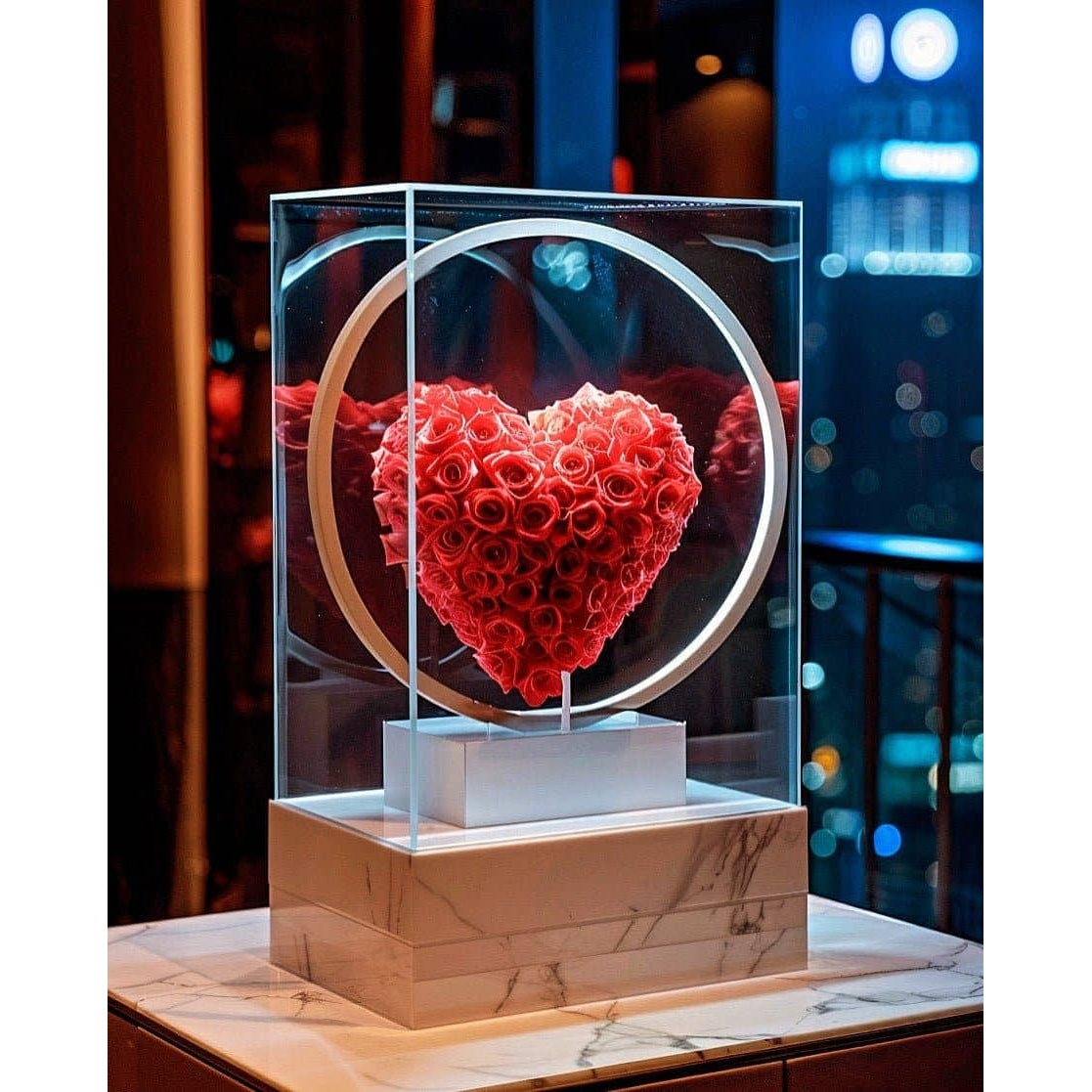
Rose light after dark
What are preserved roses used for?
Preservation changes the design brief. Roses no longer have to be arranged around vase water or replaced after several days. They can be set into memory boxes, arranged across illuminated forms, repeated into figurative sculpture, or used at architectural scale. Color can remain uniform or form a motif across a stable surface.
This does not make preserved roses inherently more meaningful than fresh flowers. Fresh roses remain ideal when scent, seasonality, movement, and a living ceremony matter. Preserved roses make sense when the gift or artwork is intended to remain as a physical reminder.
Preserved roses at Imaginary Worlds
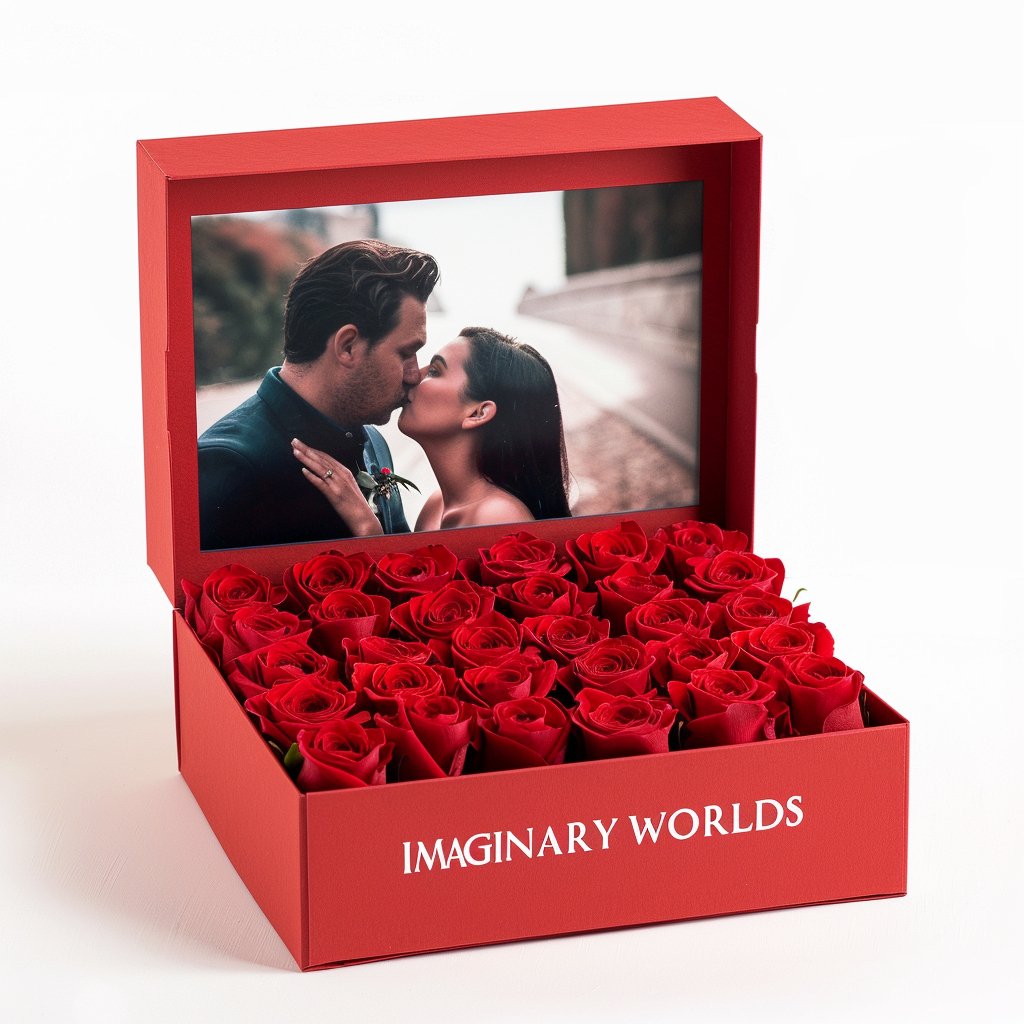
Imaginary Worlds treats preserved roses as a medium rather than an endpoint. The Memory Collection pairs flowers with photographs and personal dedications. The Light Collection considers floral texture through illumination. Floral sculptures and couture forms use repetition, silhouette, and scale to move beyond the conventional bouquet.
The underlying material knowledge matters because ambitious forms still depend on botanical variation, careful handling, and honest care. Preservation slows change; design gives that extended material life a purpose.
A preserved rose is not a fresh rose held outside time. It is real botanical material transformed for a different kind of presence.