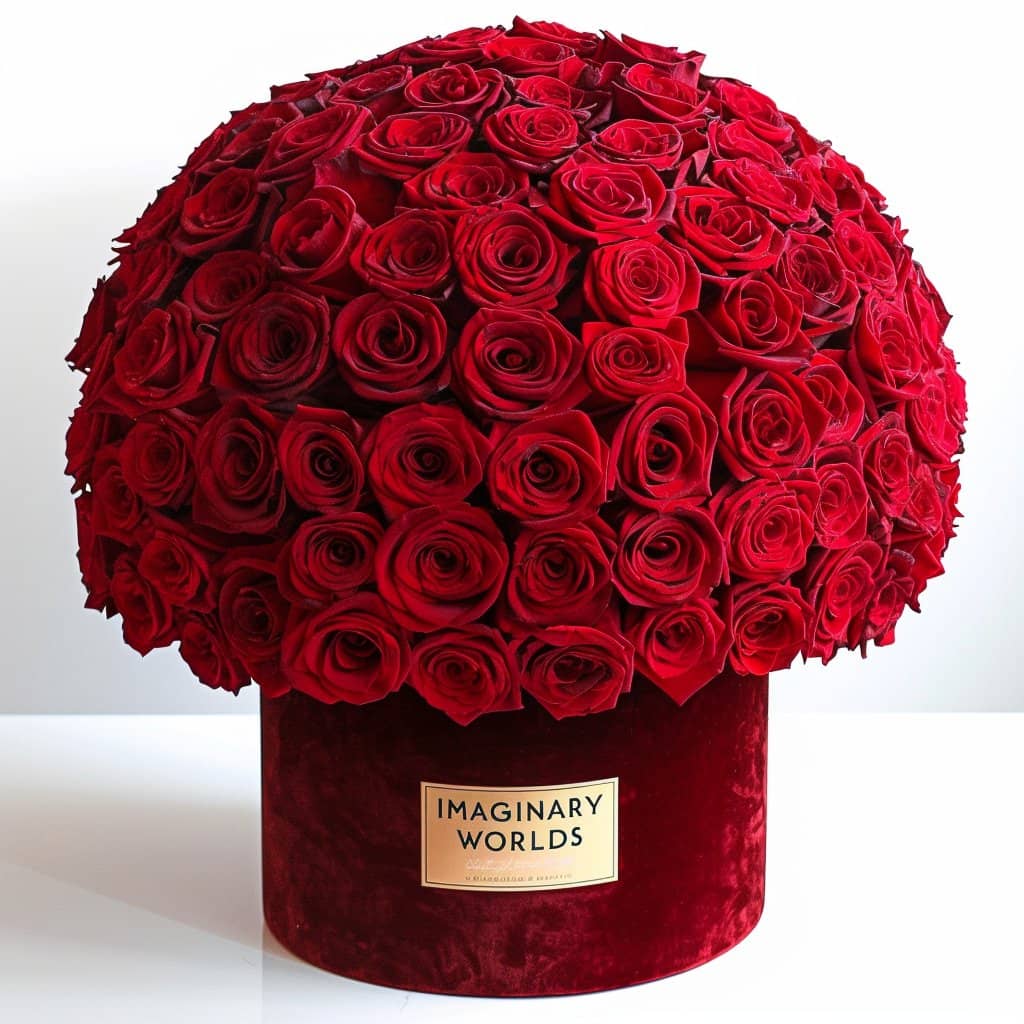
Abundance shaped into a deliberate floral silhouette.
By Imaginary Worlds Editorial
Floral Art · The IW Journal
A Ramo Buchón is a contemporary statement bouquet or floral arrangement built around abundance. It is commonly recognized by a large quantity of closely packed flowers—often roses—a rounded or dome-like profile, saturated color, and presentation designed to feel generous rather than restrained.
The Spanish word ramo can mean a branch or a grouping of flowers. Buchón is more culturally loaded and does not yield a neat, neutral English translation in this context. Usage and origin stories vary, and authoritative documentation of one inventor, date, or birthplace is limited. It is therefore more responsible to describe Ramo Buchón as an evolving contemporary style associated especially with Mexican and Mexican-diaspora gifting culture than to present a single viral claim as settled history.
Red Ramo Buchón
How to recognize the form
The first signal is scale, but scale alone is not enough. A successful Ramo Buchón gathers many blooms into a clear outline. Flower heads are placed closely so the eye reads an uninterrupted field of color rather than a loose collection of stems. The outer edge is carefully controlled; the center may rise into a dome or hold a graphic insert, initial, heart, crown, butterfly, or contrasting color pattern.
Presentation amplifies the mass. Fresh versions are often wrapped or placed in a substantial vessel. Preserved interpretations can use a box or structured base to make the arrangement more architectural. Ribbons, papers, typography, and ornamental elements may appear, but they are not mandatory. The defining quality is an unapologetic sense of plenty organized into one deliberate gesture.
Abundance, composed
Density
Closely placed blooms create a continuous surface and a feeling of generosity.
Silhouette
A dome, heart, or controlled mass prevents the quantity from becoming visually shapeless.
Color
One saturated hue can intensify the whole; contrasts can introduce symbols, initials, or emotional codes.
Presentation
A vessel, wrapping, and scale turn the arrival of the flowers into part of the experience.
A contemporary language of gifting
Ramo Buchón belongs to a social world in which the visibility of the gesture matters. Its generous scale photographs clearly, creates an immediate reveal, and gives the recipient something that feels ceremonial before a word is spoken. Social platforms have helped the style travel, but visibility should not be confused with origin: online popularity is one chapter in an evolving floral language, not proof of an ancient or uniform tradition.
The form can accompany birthdays, anniversaries, graduations, courtship, or personal milestones. Meaning is set by the relationship and occasion, not guaranteed by size. A large bouquet can communicate devotion, celebration, pride, theatrical humor, or simple delight in excess. Cultural awareness begins by allowing that range rather than reducing the style to a stereotype of luxury.
Why maximalism requires discipline
Minimal arrangements reveal every stem and gap. Maximal arrangements present the opposite challenge: how to prevent visual abundance from becoming noise. Repetition creates rhythm, but slight variations in bloom size and petal direction keep the surface alive. A strong perimeter contains the energy. Color blocking guides the eye, while a contrasting motif must remain legible across curved floral terrain.
This is where floral skill becomes visible. The maker balances count with proportion, ornament with clarity, and frontal impact with dimensional form. More flowers do not automatically produce a stronger Ramo Buchón; the composition must make the quantity feel intentional.
Preserved roses and the lasting arrangement
Fresh roses bring fragrance, movement, and a living sense of occasion to the form. Preserved roses offer a different interpretation. Because the blooms need no vase water and change more slowly, the dense surface can be secured within a structured vessel and designed as a display object. Color and motifs can remain legible beyond the day of presentation.
That duration suits the idea of a commemorative gesture, but it changes the sensory character. A preserved Ramo Buchón will not open, scent a room, or move like a fresh bouquet. Its value lies instead in stable form, tactile pattern, and the continued presence of the occasion it was chosen to mark.
The visual achievement of Ramo Buchón is not excess alone, but excess given a clear form.
The Abundance Collection
Imaginary Worlds approaches Ramo Buchón through The Abundance Collection: preserved roses organized as color, pattern, and emotional scale. The relationship to the wider floral style is clear, while the preserved medium shifts the arrangement toward an object made to remain.
Future editorial work should continue to document the form through voices from florists and recipients within Mexican and diaspora communities. That primary-source context is still a meaningful gap. Until then, the most honest reading begins with what can be seen: density, silhouette, color, presentation, and a gesture designed to occupy space without apology.